Excerpt & translation from an article published in La Vanguardia, May 27, 2026.
«In the context of the anniversary marked by the Year of Architecture (designated by UNESCO) and the congress of the UIA—the global professional association of the discipline—this text seeks to offer a personal reading of architecture in our city, connecting our past with the future.
The specificity of Barcelona begins with its geographical position, between the sea and the mountains—at once the North of the South—a climatically mild place and a historic meeting point of cultures.
The contemporary city begins in 1854, when the historic city—close to the sea—managed to demolish the walls that enclosed it and expand towards the plain. At that moment, the Ensanche (Eixample) emerges with the project by Ildefons Cerdà, which, fortunately, was realized.
One of the major events this year will undoubtedly be a large exhibition dedicated to this fundamental figure, not always fully appreciated.
In this new scenario, with the historic city opened up and the new one yet to be built, architecture emerges in a dual sense: the recomposition of the old city through new but integrated interventions. Via Laietana appears—an example of “sventramento” (another legacy of Cerdà)—with architecture of its time and intelligent interventions, radical yet at the same time conservative. These include relocating historic façades affected by the avenue’s layout to other parts of the old city, constructing the neo-classical façade of the Gothic Cathedral (1924), and many other modern yet integrated interventions that still allow large parts of the old city to be inhabited and used today. Old and new fused together.
Within the Ensanche, during the intense construction activity from the second half of the 19th century to the 1930s, numerous architectural works were built. Antoni Gaudí is certainly present, but his presence should not overshadow the large number of high-quality works produced by valuable architects across different styles (Modernisme, Noucentisme, Rationalism, etc.).
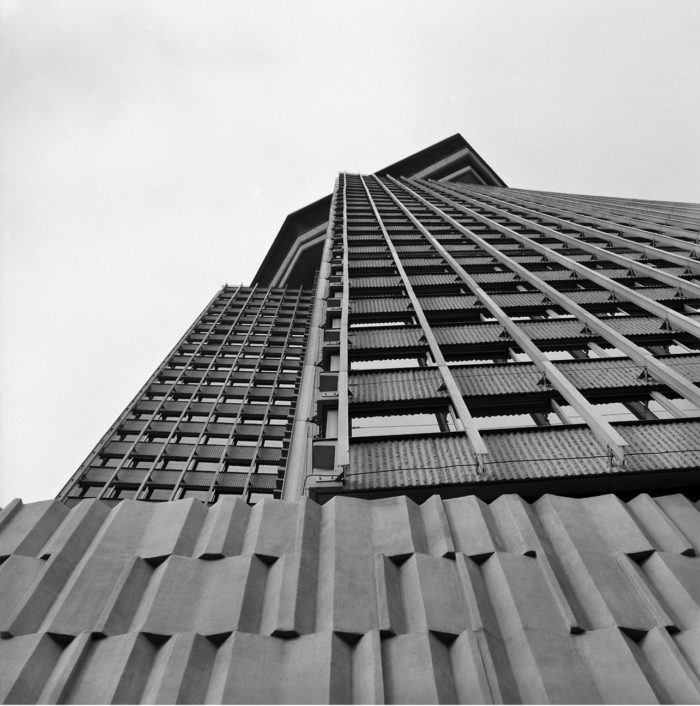
Later, the city expanded towards the mountains (1950s–60s), in a more dispersed manner, but also with architecture and architects of great quality, such as José Antonio Coderch, Francesc Mitjans, and many others.
Even within some of the housing estates of that period—mass residential developments built for the industrial workforce under conditions of urgency, speed, and economic hardship—there are examples of great quality, such as Montbau.
Architecture is the activity that connects needs, dreams, and even delusions—immaterial values—with matter, with the physical, real world. Incidentally, in today’s world, with such a strong presence of the digital and the immaterial, its opposite—the physical presence of things—is more necessary than ever.
The making of architecture and the city, alongside the architect, involves two direct actors: the administration, which regulates and organizes needs, and the developer, who connects capital and product.
Our city has, at many moments, demonstrated this relationship as positive—where necessity and profit align with quality and, ultimately, with beauty.
If administration focuses solely on bureaucratic regulation and development solely on profit, quality disappears, and with it the city becomes banal, and urban space risks vanishing.
Our city is a meeting point of contemporary activity—not a beautiful but lifeless place like today’s tourist Venice. This is a value to protect and continue, and the best way to do so is to move forward, to create across multiple domains—something that architecture will ultimately give form to.»
Josep Lluís Mateo, Architect

Ildefons Cerdà i Sunyer, Public domain, via Wikimedia Commons

Josep Lluís Mateo recently took part in the colloquium “Barcelona 2026: Year of Architecture” held at the Círculo Ecuestre in Barcelona, alongside architect Benedetta Tagliabue and Barcelona’s Chief Architect Maria Buhigas. The discussion, moderated by architect José Ribas Folguera and sponsored by CaixaBank, reflected on the future of the city in the context of Barcelona being designated UNESCO-UIA World Capital of Architecture 2026
During the conversation, the speakers addressed key challenges for contemporary cities, including urban identity, housing, public space and the role of architecture in improving everyday life. Mateo emphasized architecture as the discipline that gives physical presence to “dreams, ideas and collective needs,” highlighting the importance of maintaining qualitative ambition in the built environment.
The debate concluded with reflections on the future of Barcelona, underlining the importance of preserving the city as a vibrant centre for knowledge production and architectural culture.