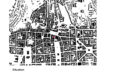

In the historic center of the 19th-century city, marked by the clear formal and architectural influence of Vienna and Budapest, stands an exceptional contemporary work that speaks to both the past and the future.
It is the Met Boutique Hotel.
The site, the green horseshoe-shaped area with its historic buildings, often converted into public spaces (museums, etc.) exhibits a clear morphological and spatial continuity.
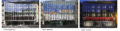
Within this context, the new structure appears both continuous and diverse. The view from the street reveals a geometry that engages in an extraordinary dialogue with the existing surroundings, along with a materiality that is entirely different yet complex: at times reflective, transparent, or translucent. The light glass façade is not a standard curtain wall. On the contrary, it is full of subtilities making its modernity more complex and attractive. In contrast to the perforated stone mass of the neighboring buildings, here we have a surface that is seemingly uniform yet variable depending on the circumstances. Its encounter with the sky (the upper edge) and with the ground (the street) is extraordinarily attractive and subtle, being continuous at the street level, without the steps that normally appear, and connecting the two different neighboring building heights with a sloped roof/inclined line.
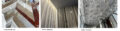
The interior is clearly defined by extreme materiality and a constant focus on detail, where the space is tactile as well as visual. In the contemporary world, with the systematic presence of industrial abstraction, this project reminds us of the explosive power of artisanal realism. The resulting space, in addition to shining at its boundaries, sometimes appears, necessarily domestic, easy, and simple, while at other times it retains a more sacred and monumental character.
This building undoubtedly represents a significant milestone in the Zagreb’s contemporary architecture, standing in active dialogue with the best of today’s European architectural culture.
Josep Lluís Mateo
